Steering Diffusion Models to Rare Events
with Sequential Monte Carlo
net speed-up over Monte Carlo on a climate emulator, growing with rarity
event probabilities recovered to within a few percent of the reference
works at inference time with any pre-trained score model
- Rare events are where scientists most want answers: record heatwaves, failure modes, crop failures. Plain Monte Carlo needs roughly 1/p samples just to see one.
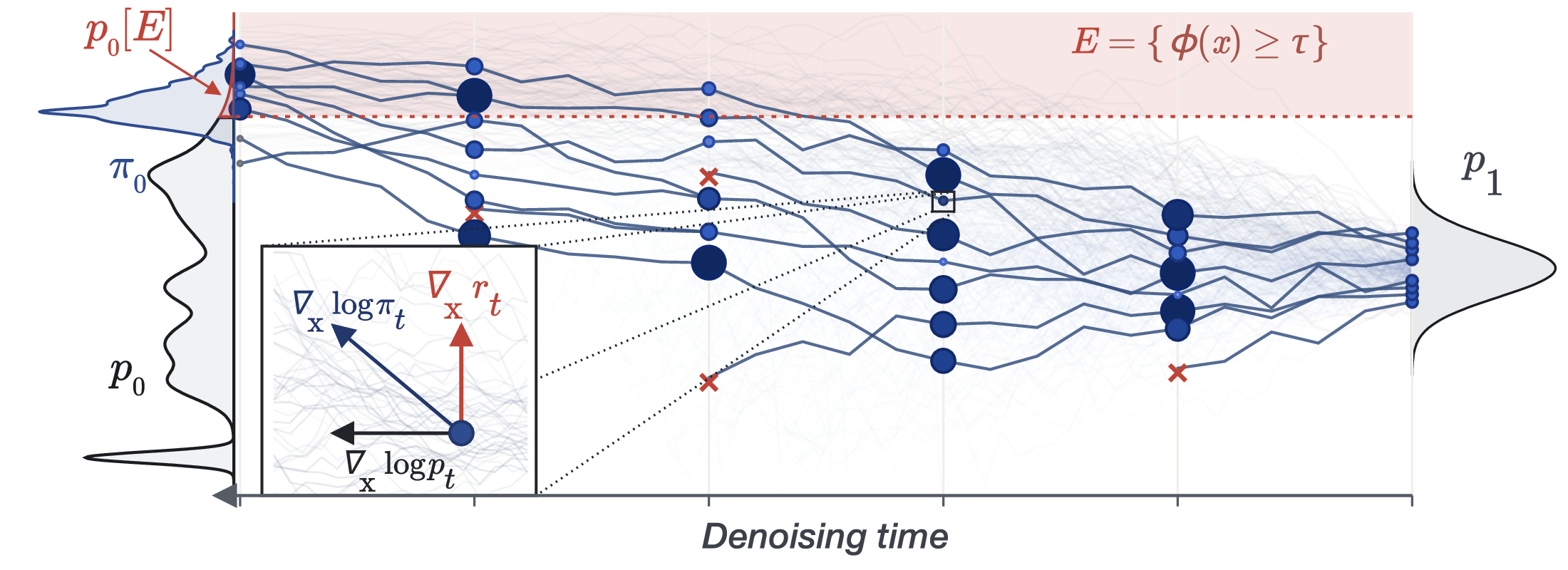
- A diffusion model already walks from noise to data through a sequence of distributions. We use that walk as the bridge that classic rare-event methods have to build by hand.
- DireSMC steers a population of particles towards the event and tracks importance weights as it goes. You get samples of the event and an unbiased estimate of its probability.
Why rare events are hard
Diffusion models now stand in for expensive simulators in weather and climate, molecular dynamics and materials design. They are cheap to sample, so the obvious way to estimate the probability of an event is to draw many samples and count.
That breaks down in the tails. The relative error of the Monte Carlo estimate is 1/√(N p), so an event with probability 10−5 needs about ten million samples for a 10% error bar. Most runs of a smaller budget see the event zero times.
Guidance can push a sampler towards the event, but on its own it changes the distribution you sample from. You get dramatic samples with no way to say how likely they are.
Steering by changing the score
A diffusion model generates samples by integrating its score ∇x log pt from noise back to data, and it lands on the data distribution p0. Change the score and you land somewhere else. We add the gradient of a reward rt, chosen so that the new endpoint is the data distribution restricted to the rare event, p0(x | E).
Getting that reward right, and correcting for the fact that we can only approximate it, is the rest of the method. DireSMC is a sequential Monte Carlo sampler that runs inside the denoising process. It needs three ingredients, and each one fixes a specific problem.
Soften, steer, weigh
Soften
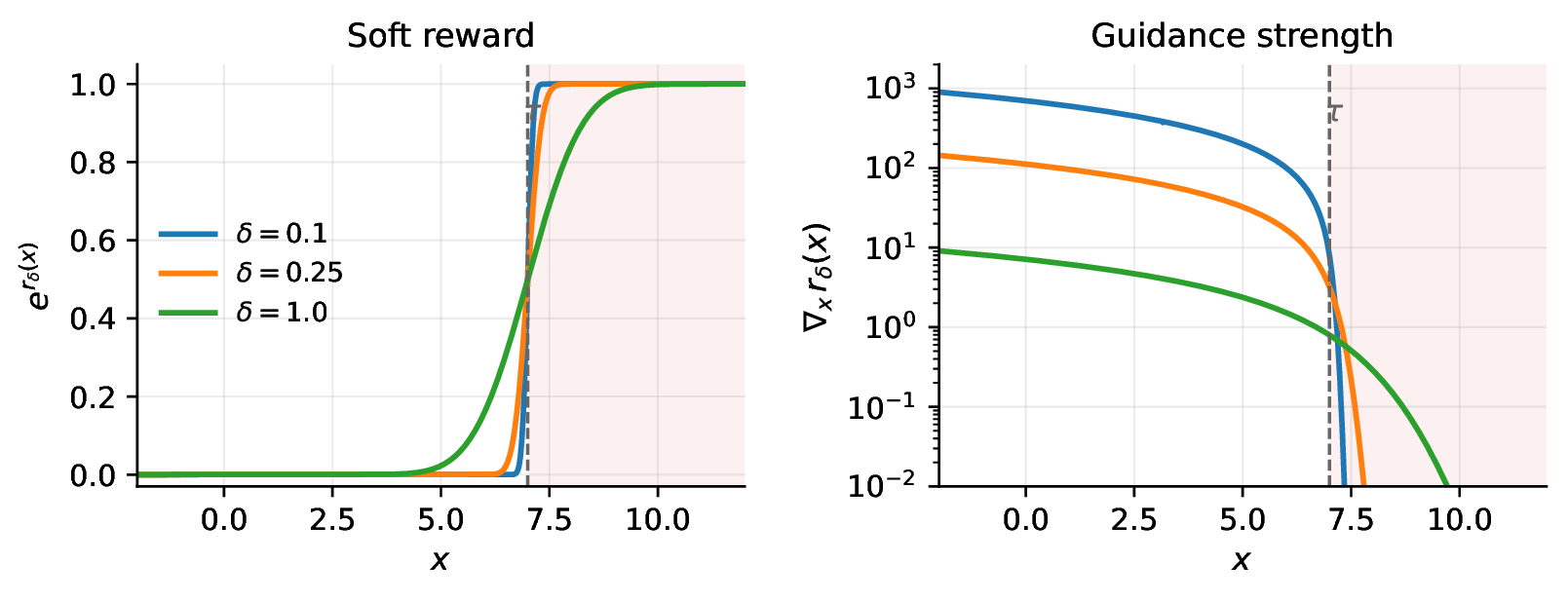
An event like φ(x) ≥ τ has an all-or-nothing indicator with zero gradient almost everywhere. We swap it for a smooth Gaussian-CDF reward that still points towards the event from outside it.
Steer
At each denoising step we look ahead to the model's guess of the clean sample (Tweedie's formula) and add the reward's gradient to the drift. For linear observables this look-ahead is closed-form.
Weigh
Every particle carries a weight that corrects for the steering. When the weights degenerate we resample and refresh particles with an MCMC move. The weights inside E estimate p0[E].
Experiments
We test DireSMC on a Gaussian mixture where the exact answer is known, and on a pre-trained climate emulator.
Checking against an exact answer
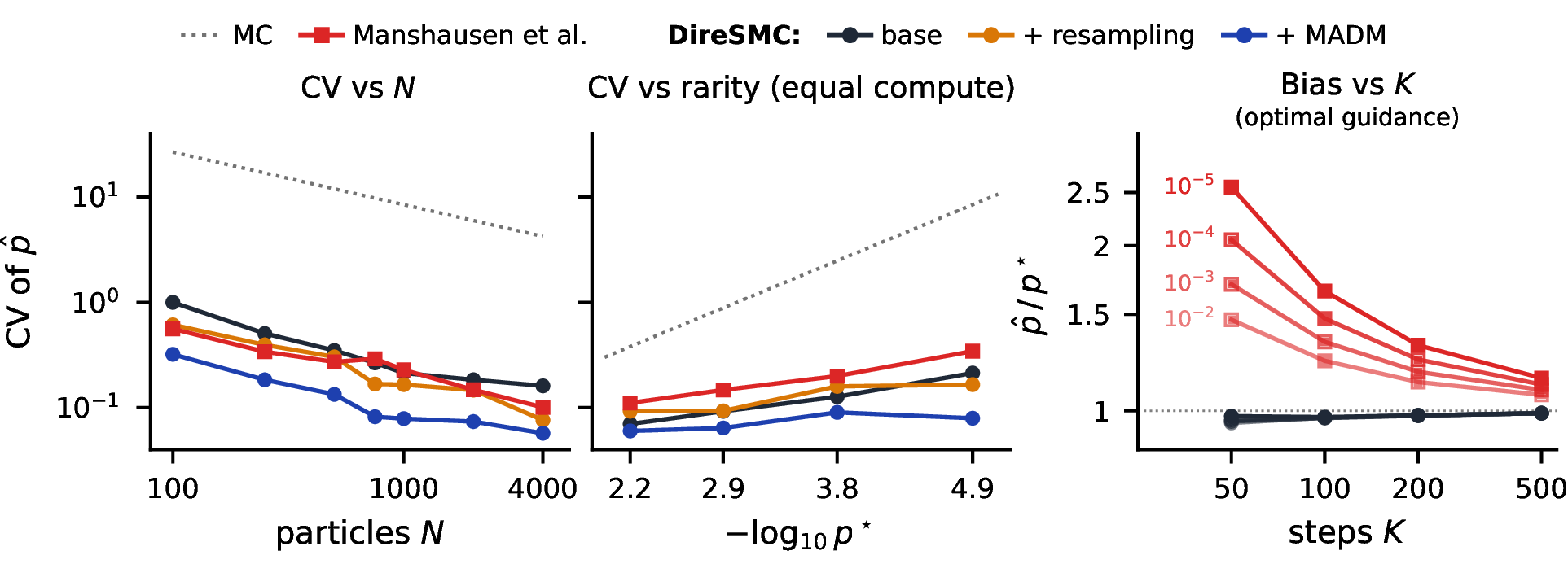
We first test on a seven-mode Gaussian mixture where the true probability is known in closed form. Events of the form x1 ≥ τ range from about 7 × 10⁻³ down to 1.4 × 10⁻⁵.
DireSMC recovers the reference with both the analytical and a learned score. Its coefficient of variation stays flat as the event gets rarer, while Monte Carlo at the same budget gets steadily worse. We also compare with the importance-sampling estimator of Manshausen et al. (2026), which uses the probability-flow ODE: DireSMC has lower variance at equal compute and a much smaller discretisation bias.
Heatwaves in a climate emulator
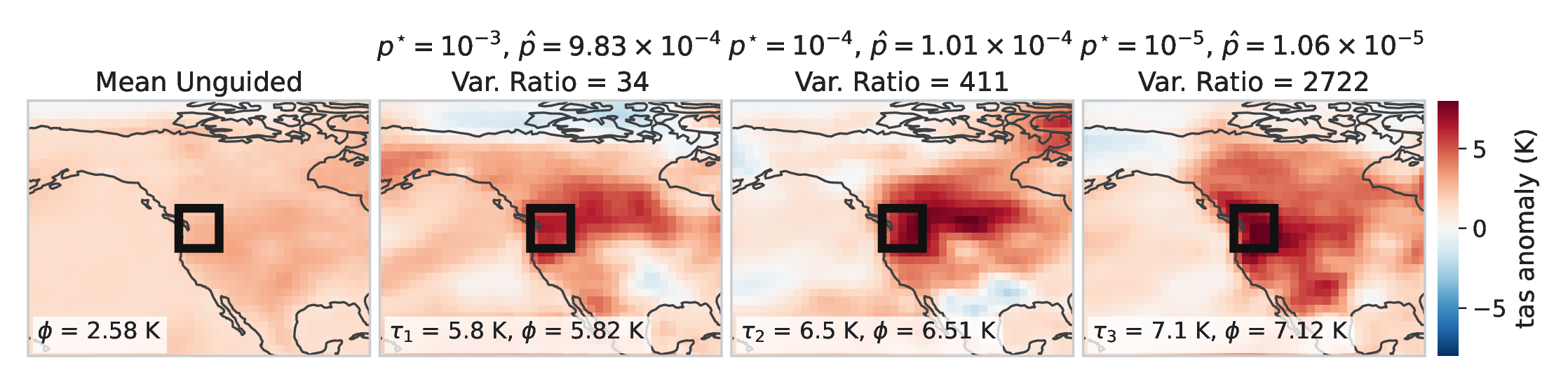
We take a pre-trained score-based climate emulator (Bouabid et al.), trained on CMIP6 output from MPI-ESM1-2-LR. It generates global monthly fields of temperature, precipitation, humidity and wind, conditioned on the month and the level of global warming ΔT.
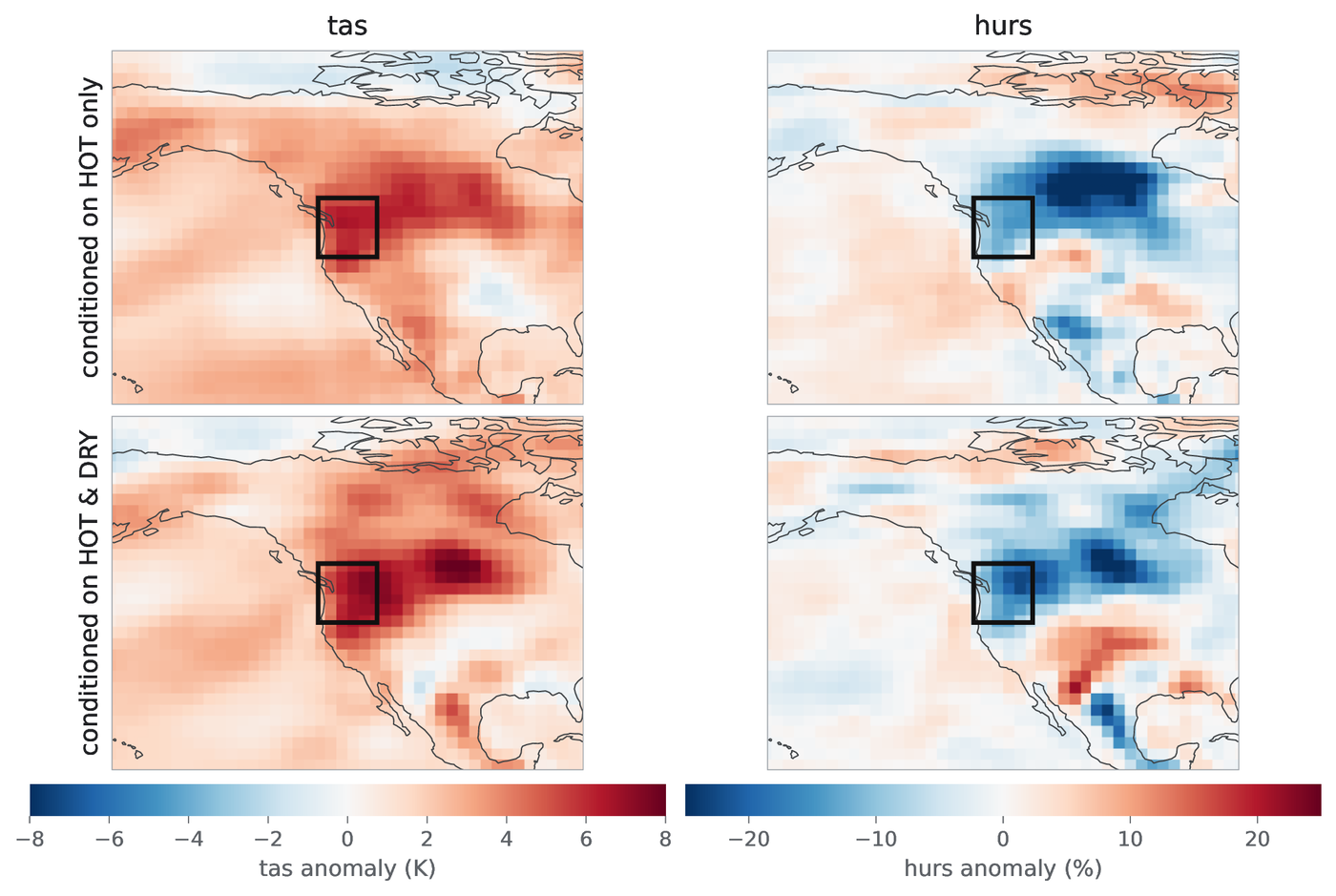
We target the region hit by the June 2021 Pacific Northwest heatwave and ask how likely an extremely hot July is at ΔT = 1.5 K. The reference comes from about ten million Monte Carlo samples.
Multivariate extremes
Compound events matter because the variables move together. We ask for Julys that are both extremely hot and extremely dry over the region, using a single reward on both variables. DireSMC recovers the joint probability and the dependence ratio d, which compares the joint probability with the product of the marginals.
| Reference p* | p̂ / p* | CV | Dependence d* | d̂ / d* | Net speed-up |
|---|---|---|---|---|---|
| 3.14 × 10⁻³ | 0.97 ± 0.02 | 0.07 | 31 | 1.04 ± 0.02 | 9× |
| 2.12 × 10⁻⁴ | 0.99 ± 0.03 | 0.11 | 212 | 1.02 ± 0.03 | 47× |
| 1.39 × 10⁻⁵ | 1.04 ± 0.02 | 0.08 | 1384 | 1.06 ± 0.06 | 1413× |
Mean ± standard error over 16 seeds. Net speed-up is the Monte Carlo compute needed to match our variance, divided by our compute with the cost of guidance included.
The dependence grows sharply with rarity. At the rarest level a hot and dry July is over a thousand times more likely than treating heat and dryness as independent would suggest.
Climate attribution
The emulator is conditioned on global warming, so we can ask how the odds of one fixed extreme change as the planet heats up. We hold the threshold at a level that is about a 1-in-10,000 event at 1.2 K of warming, roughly the 2021 climate.
Its probability goes from about 10−6 in a pre-industrial climate to near certainty at 4 K. DireSMC tracks all six orders of magnitude with the same settings. At equal compute, Monte Carlo records no events at all in the coolest climates.
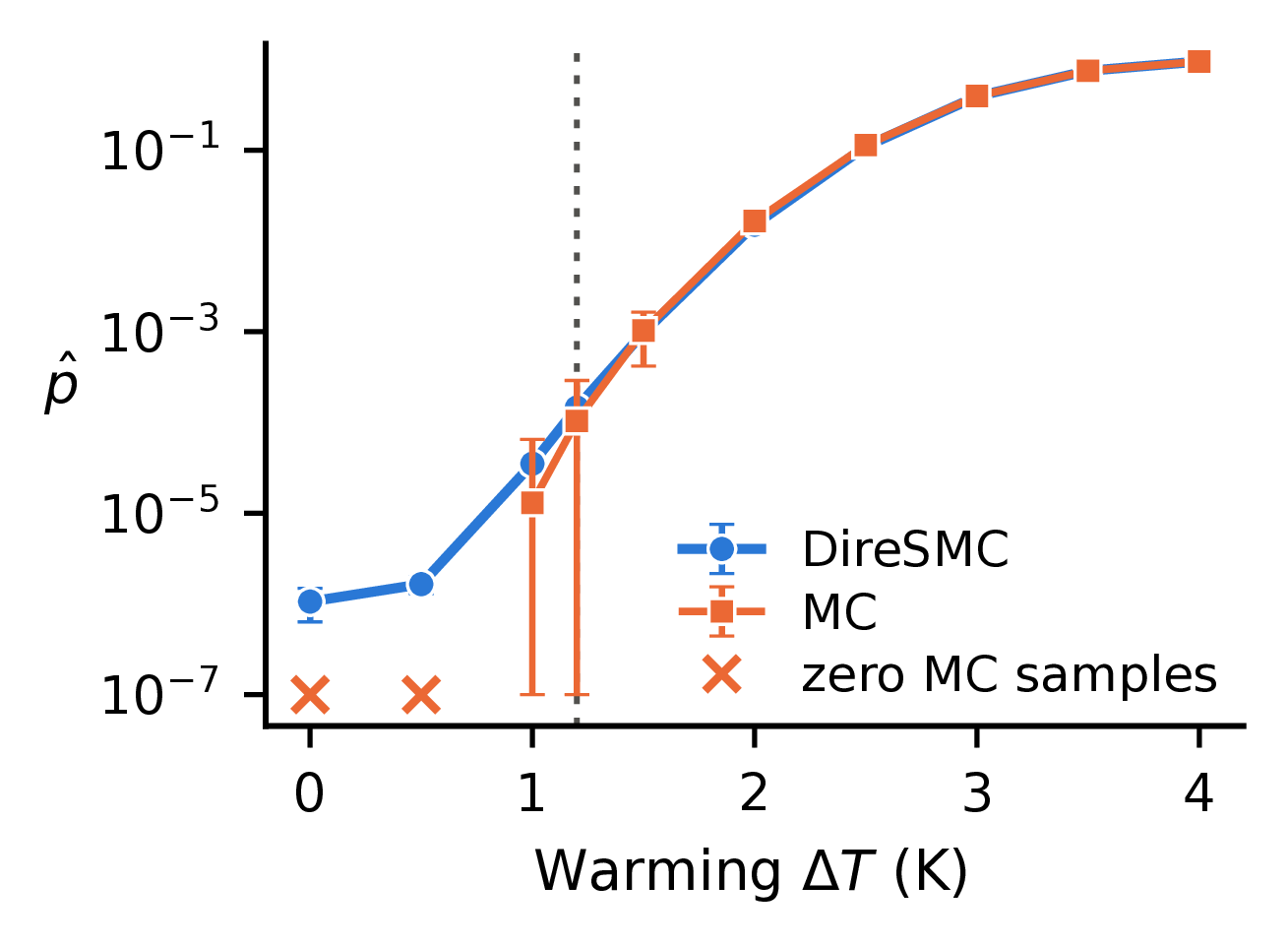
This points towards using generative emulators for event attribution: asking how much more likely a given extreme has become because of warming.
BibTeX
@article{subedi2026diresmc,
  title   = {Steering Diffusion Models to Rare Events
             with Sequential Monte Carlo},
  author  = {Subedi, Aavash and Reichelt, Tim and Williams, Christopher
             and Stier, Philip and Teh, Yee Whye and Syed, Saifuddin},
  journal = {arXiv preprint},
  year    = {2026}
}